
There is a certain stereotype of the Left that goes something like this: they are all wide-eyed idealists living in ivory towers and the moment they are given any political power they are given to acts of brutality. The historical roots of this are not entirely incorrect, they predate Marx and the First International, but the reality of the Leftist program is an incredibly pragmatic approach to society. There are certainly wide-eyed idealists, but this is not a symptom specific to the Left. There are idealists of every stripe. The truth is, the contemporary Leftist program is incredibly realistic and pragmatic. The problem is that the Left has lost the battle of image.

The image of the Left has had to withstand one anti-red campaign after another by the most powerful voices in society, and still the message of social justice and worker democracy is the most profoundly revolutionary force in the world. What the Left demands is that those who work the factories should own them. The Left has fought and gained all the best element of today's world (worker protection, minimum wage, guaranteed health care, equal rights for minorities, women's rights, etc.) and this did not happen in a vacuum. The capitalists of all times and in all places have fought as hard as they could to stop each and every advancement of democracy.
Where is the Left now? Buried under a crisis of image. Where is the story of the Left being told? What is the story of the Left? Weren't they all done away with? The Left is so marginalized in the discussion in the West (and especially in the United States) that the image is created by the enemies. How did this happen, and what can the Left do to resurrect itself and overcome the crisis of image?
Karl Marx and 'Scientific' Socialism
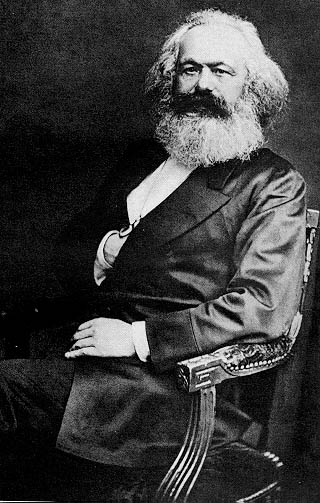 There is no purpose for a verbose history lesson here, but a quick sketch can clear some of the air. The birth of the modern Left, as most scholars would put it, happened at some point in the lifespan of the International Workingmen's Association (often called the First International). Amid the boiling proletarian rage and bourgeois idealism of the mid-nineteenth century came a world-wide organization which included many political ideologies focused on working people. While reactionary elements existed within the organization, it was primarily a socialist group. Anarchists, communists, and trade unionists made up the membership, including such luminaries of the Left as Mikhail Bakunin, Frederick Engels, and Karl Marx.
What made the Marx/Engels formulation of the socialist program so compelling, and what put it in the leading position of the worldwide Left for a hundred and more years, was the crafting of what Engels called a 'scientific' socialism.[1] This new socialist methodology (namely, the materialist conception of history) turned the Left from moral arguments to historical arguments rooted in material realities.
New concepts like the crisis of capitalism, origins of class, and the materialist conception of history sprouted from scientific socialism. While the true "science" of the line can be debated, the name has stuck for a variety of reasons, the main one being that it strikingly separates it from Utopian and religious socialism.
After the revolutions of Lenin, the civil war in Spain, the rise of trade unionism, and the failure of the German Social Democratic Party, new Leftists were quickly gathering a rich historic library of experiences to draw on for theoretical clarity. Along with the romantic concept of the "lone visionary" attributed to modernism, a new breed of Leftism was growing out of these experiences. One can see why. The romantic nature of revolution, both successful and not, and the developing culture of the Left gave birth to the what Lenin called "left wing" communism and what is commonly referred to as "ultra-leftism". [2]
The worker struggles in the developed countries at the time led to multiple "red-scares" in which the strongest bastions of the capitalist press demonized the proletarians who fought for a better world. This is important. The insidious paranoia of these propaganda campaigns helped to distort and sour the public image of worker democracy.
The New Left and Mao
Fast forward almost half a century and the scene has altered. The "New Left" is made up predominantly of college students and the drop out culture who fight for revolution in France and against the Vietnam War in the United States. The stigmas of the ultra-left seem to float from the Bolsheviks lips to the talking heads of the bourgeoisie.
The ready made stereotypes of the idealist with a head in the clouds is championed with the addition of fear-mongering over exaggerated statistics of Stalin and Mao's crimes. This was exacerbated by the tendency of 60's French radicals towards fashionable Maoism. The outcry from the West over Mao's Great Leap Forward and Cultural Revolution helped forge the sense that the Left were bloodthirsty tyrants. While Mao Zedong was certainly not the kind of socialist who would garner support from much of the contemporary Left, it is worth noting that during the "horrendous" Great Leap Forward, capitalism killed more people (both in percentage and in total) in India than any programs did in China. [3]
It is also important to note that during this time the two largest propaganda contraptions in the world (the capitalist West and "Soviet" Russia) were working to convince the world that Russia was socialist, despite the obvious evidence to the contrary. If socialism is worker control of the means of production, then Russia was one of the countries furthest from socialism. [4]
 Meanwhile, in the US, the stereotype of the college student as the front line of the Left was being sold. This was in direct contrast to the actual public opinion of the matter, where the working class was far more likely to oppose the war than those with or getting a college education. [5] This is not to, in any way, diminish the contributions made by the vocal campus anti-war movement of the 1960's and 70's. What must be remembered, however, is that these contemporary stereotypes come to define our historical perspective but that makes them flawed because the stereotypes are flawed. Yes, organizations like the Students for a Democratic Society (SDS) did great work in fighting to end the war, but it was not the SDS, or any student groups, who did the work alone.
The fact is the elite press gave voice to the elite dissent of the campuses and not the proletarian dissent of the ghettos and boroughs throughout the United States at the time.
And so the historical development of the movement within the dialectic of class war produced the image found today, the left: hopeless Utopians with a thirst for blood.
Moving to Madison Avenue
What does all this mean? It means there is a crisis of image for the Left. It means a lot of views about the Left are unfair and untrue. It also means that if the Left fixes its image, it could benefit greatly and expand its still potent base.
 After all of the major campaigns worldwide to degenerate the image of the Left into stinking hippy psychopaths, the perennial appeal of worker democracy remains. In the United States, the heart of all things anti-red, "socialism" polls positively with over a third of the people, and polls better than "capitalism" among the young, the working class, and blacks. [6] [7] This is in the face of over a hundred years of bitter defamation by the most powerful voices in the country. So how does the Left take this third of the US and turn it into a majority and, perhaps, a super-majority?
There has been a lot of critique from the Left on the practices and aims of the "Madison Avenue" advertising style that came from modern capitalism. The creation of want and the celebration of consumerism are the main crimes dropped at the door of these ad men, but it is clear that the Left could learn a lesson or two from Madison Ave. Any stigma against the techniques of propaganda which have served the capitalists so well should be done away with as they are predominantly dogmatic and useless. What the Left needs is to take back control of its image and put the capitalists on the defensive, and the world has long left a time when all you had to do was strike and organize a party.
Now, there is certainly value in striking and organizing parties. What there is not value in is clinging to these as the only means to further worker democracy in the West. The world has changed and propaganda techniques have developed into highly savvy operations. There is probably no way the Left could compete with capitalists on the money front. Part of what makes the capitalist propaganda so effective is its ubiquitousness on major media, but the Left has the people who can do many small things, its own kind of ubiquitousness.

What are the legal détournement available? This is the difficult question, but in many ways it is the only question facing the Left right now. The current historical moment happens to be the exact place socialists have said capitalism would end up, and the world working class is in revolt. Consciousness of the discrepancies between the classes is beginning to reemerge in the West. The time for the Leftist narrative to be inserted back into the public debate is now, but the Left has to be prepared to steal the techniques of image from the capitalists to vanquish wage-slavery and institute worker democracy.
Notes and Bibliography:
1. Frederick Engels, "Socialism: Utopian and Scientific," Revue Socialiste, March, April, May 1880. [Here]
2. Vladimir Lenin, "Left-Wing" Communism: an Infantile Disorder (1920) [Here]
3. Ansley J. Coal, "Population trends in China and India (A Review)," Proceedings of the National Academy of Sciences of the United States of America 80 (1980): 1758 [Here]
4. Noam Chomsky, "The Soviet Union Versus Socialism," Our Generation, Spring/Summer 1986. [Here]
5. Howard Zinn, A People's History of the United States (New York: Harper Collins 1980), 469-502
6. "Little Change in Public's Response to 'Capitalism,' 'Socialism'" last modified December 28, 2011 [Here].
7. "Socialism Viewed Positively by 36% of Americans," last modified February 4, 2010 [Here]

No comments:
Post a Comment